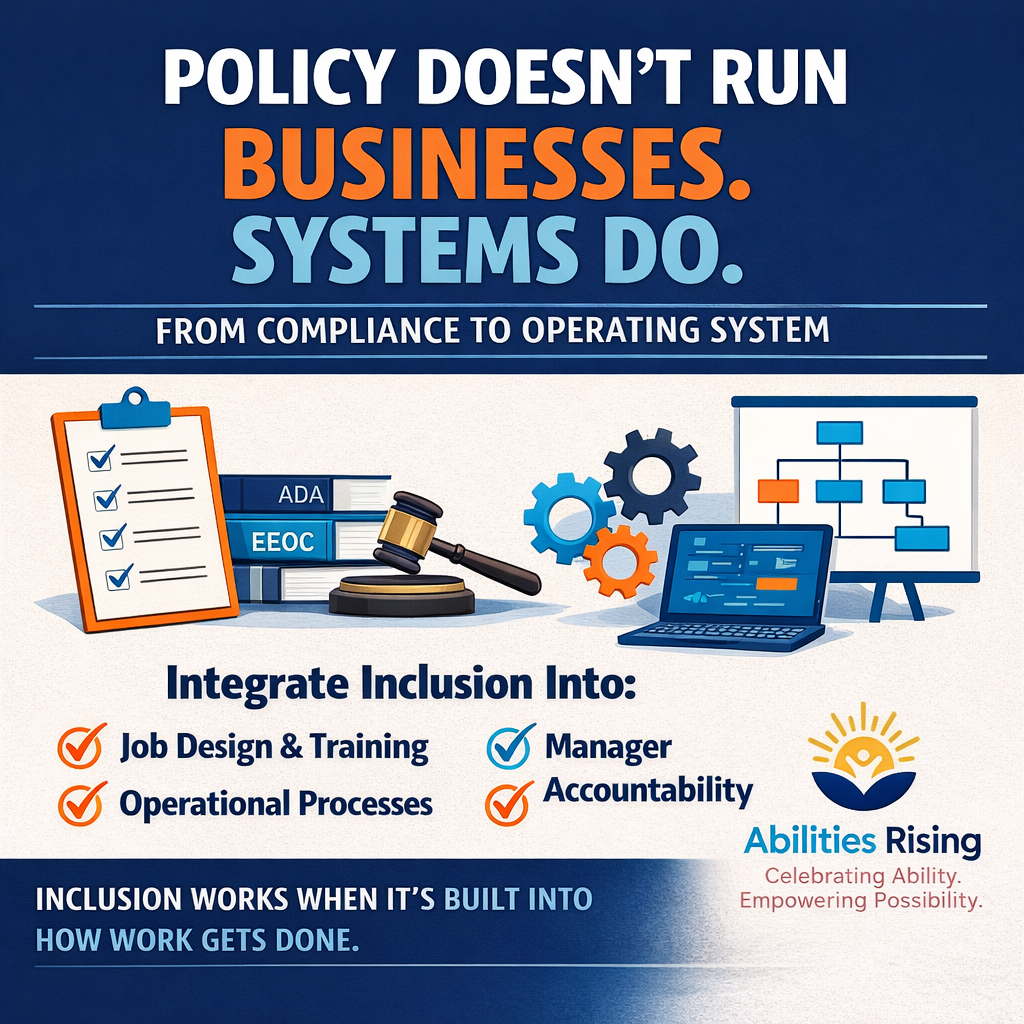
For years, disability inclusion in the workplace lived in the same category as safety posters and legal disclaimers: necessary, important, and largely disconnected from how work actually got done.
That is changing.
According to the 2025 Disability Index, corporate disability inclusion is moving from a legal requirement to a strategic imperative. Leading companies now measure it with the same rigor as financial and environmental performance. The message is clear: inclusion is no longer aspirational, it is operational.
And yet, despite progress, many organizations are stuck.
They may big statements.
They write impressive policies.
They may even create training modules.
What they don’t have is an operating system.
Why Policy-First Inclusion Breaks Down
Most inclusion efforts collapse at the same point: execution.
Policies live in binders.
Values live on posters.
But managers live in the real world, under pressure to deliver results.
When inclusion is framed as:
- a moral good,
- a compliance requirement, or
- an HR initiative,
it becomes optional the moment priorities compete.
That’s not because leaders don’t care. It’s because policy doesn’t run a business, systems do.
What We Learned Building a Real Business
At John’s Crazy Socks, more than half of our colleagues have differing abilities. That outcome wasn’t driven by passion alone.
We didn’t succeed because we cared more.
We succeeded because we operationalized inclusion.
That meant asking hard, unglamorous questions:
- How are jobs actually designed?
- What support do managers need to succeed?
- Where do incentives unintentionally create resistance?
- Who owns accountability when things get hard?
Inclusion became part of how work flowed, not a special program layered on top of it.
Inclusion Has to Live Where Work Lives
The companies making real progress aren’t doing more awareness campaigns. They are embedding inclusion into the architecture of work:
- How roles are defined
- How managers are trained and evaluated
- How accommodations are funded
- How systems are designed
- How success is measured
The Disability Index makes this shift explicit: sustainable inclusion must be embedded into enterprise-wide systems, not treated as a standalone initiative.
This is where many organizations hesitate because systems reveal priorities.
The Manager Test
Here’s a simple diagnostic:
If a frontline manager has to choose between:
- hitting performance goals, or
- supporting an employee with a disability,
and feels those goals are in conflict, your system is broken.
High-performing inclusive organizations remove that conflict by design. They:
- set clear expectations,
- provide real training,
- reinforce the commitment,
- and align leadership around outcomes.
Inclusion works when managers are set up to succeed, not asked to improvise.
From “Doing Good” to “Running the Business”
When disability inclusion is framed as “doing the right thing,” it stays fragile.
When it’s framed as “how we run the business,” it becomes durable.
That’s when organizations see:
- higher engagement,
- lower turnover,
- stronger teams,
- better customer experience,
- and greater resilience in times of change.
This is not theory. It’s practice.
Why This Matters Now
The 2025 Disability Index reflects a moment of transition. Companies are signaling readiness to move beyond compliance—but many haven’t yet made the operational leap.
That leap doesn’t require perfection.
It requires discipline.
It requires leaders willing to move inclusion out of policy manuals and into daily work.
A Final Thought
Inclusion doesn’t fail because people don’t care.
It fails because systems don’t support it.
When you fix the system, inclusion stops being fragile and starts being effective.
These are the conversations John and I have on stages with HR leaders, executives, and associations across the country. Not about intent, but about execution. Not about aspiration, but about how work actually gets done.
Because inclusion only works when it’s built to last.