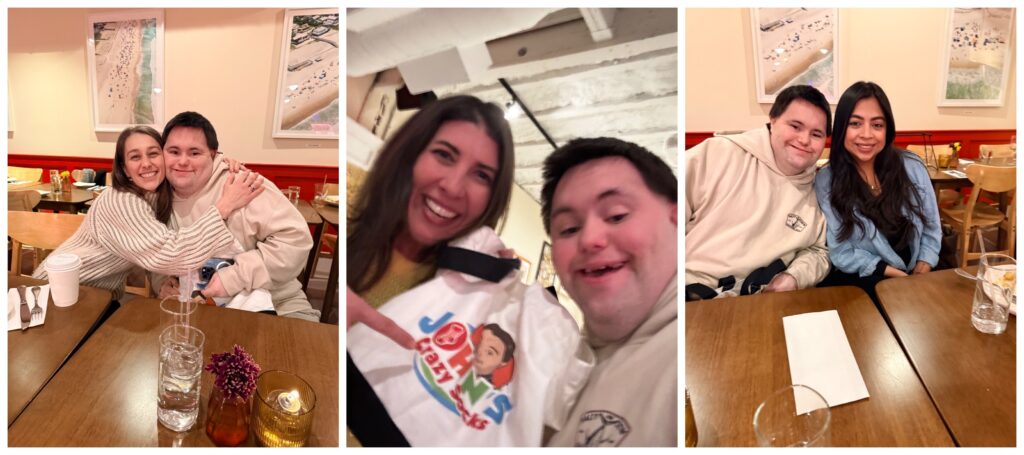
Earlier this week, John and I had the privilege of speaking with the Special Needs Parents group here on Long Island. We came prepared to share our story. What we didn’t fully anticipate was how much we would listen.
Parents shared stories that were deeply familiar to us and still hard to hear. Stories of joy and pride. Of hard-fought milestones. Of medical battles survived. Of children who worked tirelessly to grow, learn, and belong.
And then, again and again, the same moment appeared in different forms.
Age 21.
For many families of individuals with intellectual and developmental disabilities, age 21 isn’t a celebration. It’s a cliff.
The 21-Year-Old Cliff
When our children are in school, everything is right there in front of us: School. Services. Teams. Plans. Expectations. There are IEP meetings, therapists, teachers, routines, and a shared belief, explicit or implied, that someone is helping to carry the load.
Then school ends.
And too often, so does the system.
The “21-year-old cliff” is the abrupt loss of coordinated supports when a young person with a disability ages out of the school-based system. What happens next varies from state to state. Some states, like New York, Massachusetts, and California, have many services, but it can be difficult to navigate them. Other states like Texas, Mississippi, and Florida have nothing. In all cases, families are their own answering a fundamental question:
What happens now?
Not enough jobs.
Not enough housing options.
Not enough ways to belong in the community.
Parents are left to patch together solutions in a world that was not designed with their children in mind.
The Trio of Challenges We Must Face
During our conversation, I shared a framework we’ve come to believe is unavoidable if we are serious about building better futures for people with differing abilities.
There are three interlocking challenges:
Jobs.
Work provides dignity, purpose, income, and connection. Yet far too many capable adults are excluded from meaningful employment, not because they can’t work, but because employers don’t know how to open the door, don’t know how to employ them.
Housing.
Safe, affordable, and supportive housing options are limited. Independence is treated like a luxury instead of a goal.
Community.
Belonging doesn’t come from services alone. It comes from relationships, contribution, and being known. Too many adults with disabilities are isolated once the daily rhythm of school disappears.
If we ignore any one of these, the system fails. Families feel that failure every day.
Why We Chose Entrepreneurship
We shared the story of how John’s Crazy Socks began, not as a business plan, but as a response to that very cliff.
When John was finishing school, he wanted what everyone wants: a job, purpose, and a chance to contribute. The opportunities simply weren’t there. So, John said, “Dad, I want to go into business with you.”
Entrepreneurship was not a backup plan. It was an act of agency.
Together, we built a company that proved something simple but powerful: when you focus on what people can do, you create opportunity. We created jobs, built a culture of belonging, and showed that inclusion is not just possible, it’s good business.
That’s why we believe entrepreneurship must be part of the conversation. Not for everyone, but as a real, viable option that deserves support, education, and encouragement.
Practical Questions. Real Answers.
What made this evening special was the honesty of the questions.
Parents asked:
- How do you even start a business?
- How do you protect benefits?
- What skills matter most?
- How do you find the right job, not just any job?
We shared practical strategies drawn from the book I’m writing focused on strengths, interests, environments, and support systems. Not platitudes. Not false promises. Just steps families can actually take.
And we listened. Because no two paths look the same.
Why We Speak
We left that evening deeply grateful.
Grateful for parents who keep pushing when the system stops pushing with them.
Grateful for conversations rooted in honesty, not denial.
Grateful for the reminder that this work is urgent and unfinished.
The feedback afterward meant a great deal to us.
“What an inspiring story.”
“Love this.”
“Hearing how our children can have employment opportunities while learning life skills and developing friendships too.”
But what mattered most wasn’t the praise. It was the connection.
We speak because work changes lives. Because dignity matters. Because aging out should not mean disappearing. And because families deserve more than a cliff.
They deserve paths forward.
If you are a parent standing at or staring down the 21-year-old cliff, know this: you are not alone. And better answers are possible.
If you would like to hear us speak to your organization or help your adult child find a job, reach out to us at johnandmarkcronin.com.