Most conversations about workplace inclusion eventually land in the same place: culture, values, and intent. That’s understandable. Intent matters. But intent does not run an organization. Managers do.
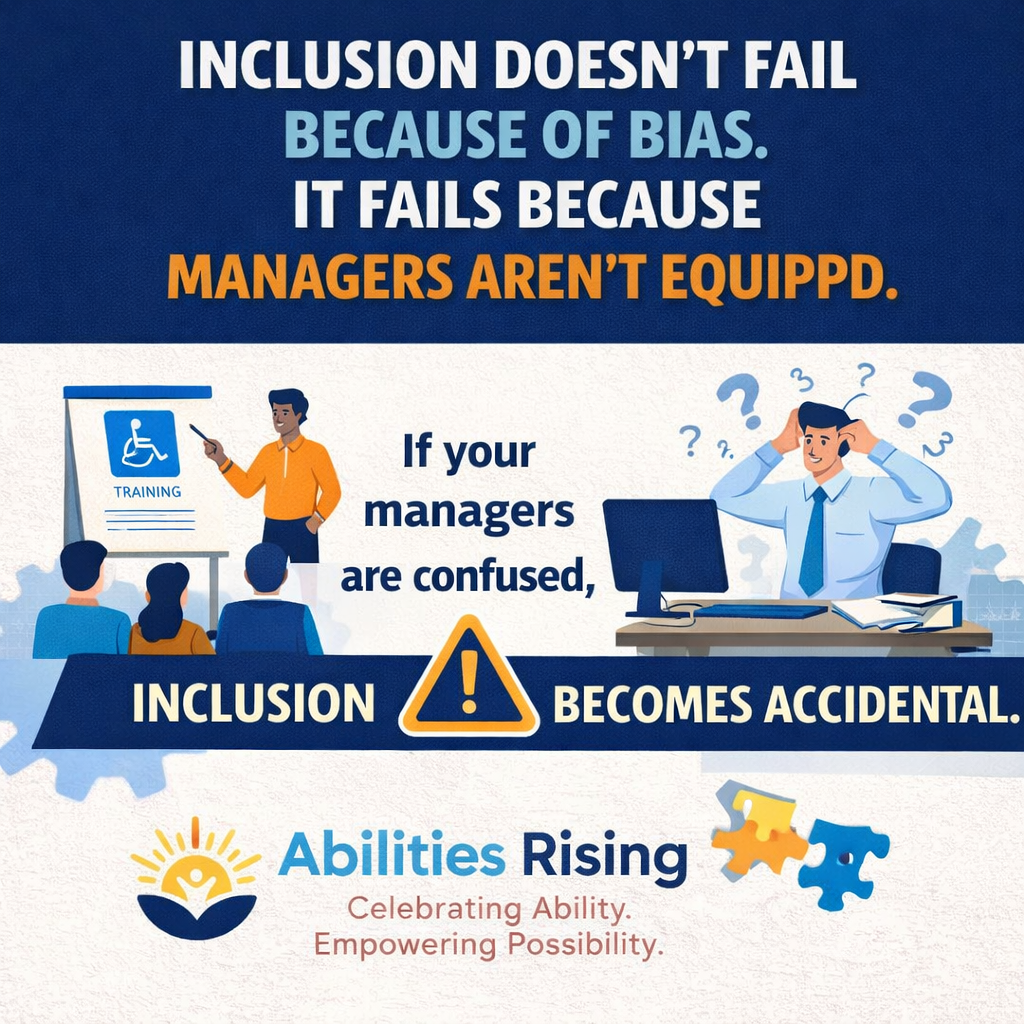
And when inclusion breaks down, it usually isn’t because leaders are biased or employees don’t care. It’s because managers receive mixed messages and are left confused, underprepared, and left to improvise.
When that happens, inclusion becomes accidental.
What the Data Is Telling Us
The 2025 Disability Index shows meaningful progress in disability inclusion over the past year. More companies are offering training, expanding benefits, and investing in employee well-being. On paper, the trend lines are positive.
But the data also reveals something critical: execution is uneven, especially at the managerial level.
More training exists. We’ve created more policies and we’ve made more pronouncements. But, too often, the outcomes aren’t there.
What’s missing is consistent, operational clarity for the people who are actually doing the work. They are given many mandates, perhaps too many, and inclusion can be just one more thing and they are left to figure how to do that on top of everything else.
Managers Are Where Policies Becomes Reality. Or Don’t.
Every inclusion strategy eventually runs through one person: the frontline manager. Managers decide:
- how jobs are structured,
- how performance is evaluated,
- how accommodations are handled,
- how team dynamics play out,
- and whether inclusion feels supported or risky.
If managers are unclear about expectations, authority, or resources, they don’t fail loudly. They default quietly:
- They delay decisions.
- They avoid conversations.
- They treat accommodations as exceptions.
- They hope HR will step in.
That’s not malice. It’s uncertainty.
The Hidden Cost of Confused Managers
Here’s the pattern we see again and again:
- HR launches a strong inclusion initiative
- Leaders express public support
- Managers receive a training module
- Messy reality shows up with all it’s competing demands and deadlines
- Managers aren’t sure what to do
- Inclusion becomes inconsistent at best or just an afterthought.
At that point, outcomes depend less on systems and more on individual comfort levels. That is how inclusion turns into a lottery.
What We Learned Running a Real Business
At John’s Crazy Socks, more than half of our colleagues have differing abilities. That didn’t happen because we found unusually enlightened managers. It happened because we made the manager role clear. We didn’t ask managers to “be inclusive.” We equipped them to succeed.
That meant:
- Clear job definitions, so expectations were explicit
- Training focused on how to manage, not just why inclusion matters
- Support systems managers could rely on
- Accountability that treated inclusion as part of performance, not a favor
Managers weren’t asked to improvise values. They were given tools.
Inclusion Is Not a Personality Trait
One of the most damaging assumptions organizations make is that inclusion depends on individual goodness. It doesn’t. Inclusion depends on:
- clarity,
- consistency,
- and support.
When managers know:
- what’s expected,
- what authority they have,
- where to go for help,
- and how success is measured,
inclusion becomes repeatable. When they don’t, inclusion becomes fragile.
A Simple Test for Leadership Teams
Ask yourself this:
If you pulled a manager aside and asked, “How do you handle accommodations on your team?”
Would they:
- answer confidently and consistently?
- or hedge, guess, and defer?
Confusion at the manager level is not a training failure.
It’s a systems failure.
Why This Matters Now
The Disability Index makes clear that companies are moving beyond compliance. But the next phase – sustainable inclusion – depends on whether organizations are willing to invest where it counts. Not just in programs. Not just in policies. But in manager effectiveness. Because managers are not a layer between strategy and work. They are the system.
A Final Thought
Inclusion doesn’t fail because of bias. It fails when managers are left without clarity.
If your managers are confused, inclusion becomes accidental. If they’re equipped, inclusion becomes durable.
These are the conversations John and I have with leadership teams, HR organizations, and associations across the country, focused not on intention, but execution.
Because when managers succeed, inclusion stops being aspirational and starts being operational.