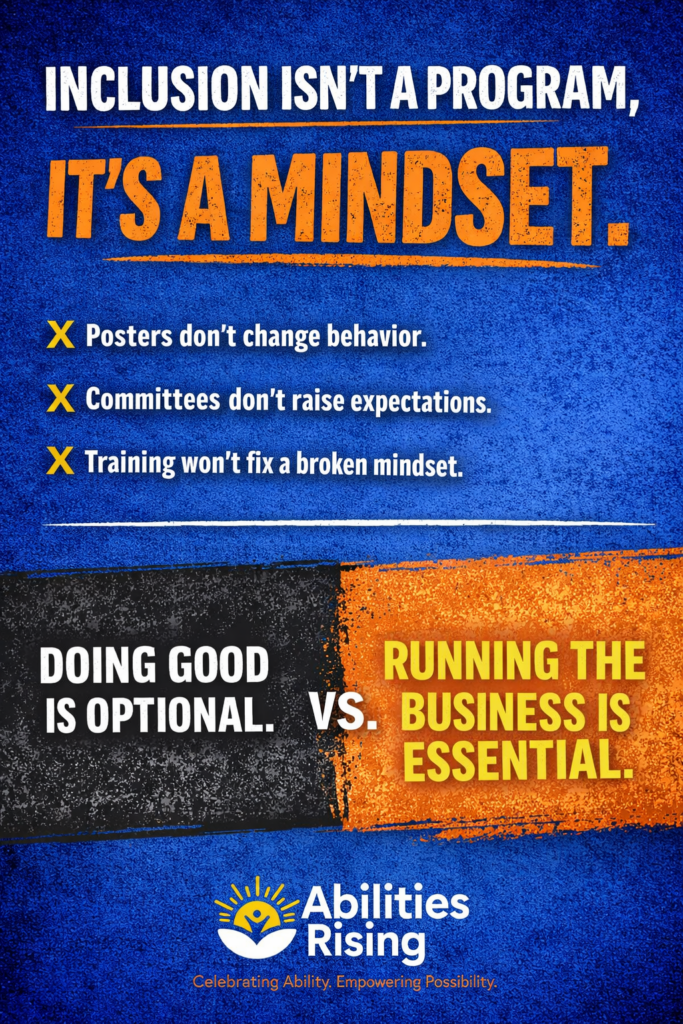
Almost every organization today claims to value inclusion, even in a day and age when some have tried to eradicate the term DEI.
They have statements. Committees. Posters. Training modules.
And yet very little actually changes.
That’s because inclusion is not a program. It is not a benefit. It is not a box to check.
Inclusion is a mindset. And if leaders don’t change how they see people, no initiative will survive first contact with reality.
At John’s Crazy Socks, we didn’t start with an inclusion strategy. We started with a decision: to reject the low expectations the world placed on John and on people like him and to build a real business anyway.
Everything followed from that choice.
The Comfortable Lie About Inclusion
Here’s the uncomfortable truth: Most inclusion efforts fail because they are built on sympathy instead of respect.
They frame people with disabilities as recipients of opportunity, not contributors of value. They focus on accommodation before expectation. They soften standards instead of clarifying them.
That approach may feel kind. It is not effective.
Inclusion that works begins with a different premise: people want to contribute, and most barriers are created by systems, not ability.
When leaders don’t believe that, really believe it, their policies don’t matter.
Where Our Story Actually Begins
John’s Crazy Socks started when John was finishing school and looking for work. Like so many young adults with differing abilities, he ran into a wall of polite rejection and low expectations.
Employers didn’t say “no” outright. They said things like “We don’t have the right support,” or “We’re not set up for that.”
So, one night John said to me, “Dad, I want to go into business with you.”
Not a nonprofit. Not a program. A business.
That moment forced a choice. We could accept the world’s assumptions, or we could challenge them. We chose to challenge them, knowing full well that belief alone wouldn’t be enough. Execution would matter.
From day one, inclusion wasn’t a talking point. It was an operating decision.
“I Don’t Want a Special Job”
John puts it more plainly than I ever could:
“I don’t want a special job. I want a real job. I want to work hard, be part of a team, and make customers happy, just like everyone else.”
That mindset shaped everything.
We didn’t ask, “What can John do despite his Down syndrome?”
We asked, “What would it look like if we built a company around what people can do?”
That’s a radically different question and most organizations never ask it.
Inclusion Is Not About Lowering the Bar
One of the biggest myths in workplace inclusion is that hiring people with disabilities means lowering standards. That belief is not only wrong, it’s insulting.
At John’s Crazy Socks, more than half of our colleagues have differing abilities. They do real work with real expectations. They are held accountable. They are trained, coached, promoted, and, when necessary, corrected. They wanted to be coached.
Inclusion works when:
- Job roles are clear
- Managers are trained
- Feedback is honest
- Standards are consistent
What fails organizations isn’t inclusion. It’s vagueness.
When expectations are fuzzy for everyone, managers panic. When expectations are clear, inclusion thrives.
HR Feels This First
When John and I delivered the keynote at the HR Indiana State Conference for SHRM, nearly 1,000 HR professionals filled the room. What happened afterward mattered even more than the standing ovation.
For over an hour, people lined up to talk.
Parents asked how to help their children build real futures.
HR leaders asked how to make inclusive hiring actually work.
Executives asked how to create workplaces where people are engaged, not just compliant.
No one asked about policy templates.
They asked about mindset, execution, and results.
That’s because HR leaders live at the intersection of intention and reality. They see where well-meaning initiatives break down. They know when leadership support is performative. And they’re tired of being handed values without operating models.
The Business Case Is Not the Point, But It’s Real
We don’t hire inclusively because it looks good in a report. We do it because it makes us better. Hiring people with differing abilities is not charity; it is good business.
Here’s what we’ve seen:
- Higher morale
- Lower turnover
- Stronger loyalty
- Expanded talent pipelines
- Better customer experience
Customers feel it. Employees feel it. And leaders who pay attention learn from it.
But here’s the key: the results follow the mindset.
Why Most Organizations Stall
Inclusion stalls when it’s treated as:
- HR’s responsibility instead of leadership’s
- A moral issue instead of a business discipline
- A pilot instead of a system
It stalls when leaders say the right things but avoid the hard ones:
- What work actually needs to be done
- How success will be measured
- Where managers need support and accountability
Inclusion isn’t fragile. Half-hearted leadership is.
What We Do on Stage and in Workshops
When John and I speak, we don’t deliver slogans. We share our experience. We show what worked, what failed, and what we had to change.
We challenge audiences to rethink:
- Talent and potential
- Management responsibility
- Culture as a daily practice, not a perk
And we don’t stop at inspiration.
Our workshops go deeper, working with HR teams and leaders on:
- Designing roles that work
- Preparing managers for inclusive leadership
- Building systems that scale inclusion without burning people out
- Aligning mission, performance, and accountability
This isn’t theory. It’s operational.
Inclusion Is a Leadership Test
Inclusion exposes leadership gaps faster than almost anything else.
It reveals whether leaders:
- Believe people are capable
- Trust managers to lead
- Are willing to examine their assumptions
That’s why it’s uncomfortable. And that’s why it matters.
Inclusion is not about being nice. It’s about being honest.
A Direct Invitation
If your organization is serious about inclusion—not as a statement, but as a way of working, we invite you to engage with us.
Bring us in to:
- Deliver a keynote that challenges assumptions
- Lead a workshop that equips HR and leaders to act
- Start a conversation your organization is ready to have
We don’t promise easy answers.
We promise clarity, candor, and a roadmap grounded in real experience.
Because inclusion isn’t a program you roll out.
It’s a mindset you lead with.
And when leaders get that right, everything else follows.