For years, organizations have puzzled over the same question:
Why don’t more employees self-identify as having a disability?
The most common answers sound reasonable:
- Employees are worried about stigma
- They don’t understand the question
- They’re concerned about privacy
- They don’t see the benefit
So, companies respond the same way:
- Rewrite the form
- Improve the language
- Launch another awareness campaign
- Send another reminder email
And then… the numbers barely move.
According to the 2025 Disability Index, the median international self-identification rate is just 3.5%. That’s not a rounding error. It’s a signal.
And it’s telling us something uncomfortable. If 27 percent of the population has some disability, why are so few willing to share that reality with their employer?
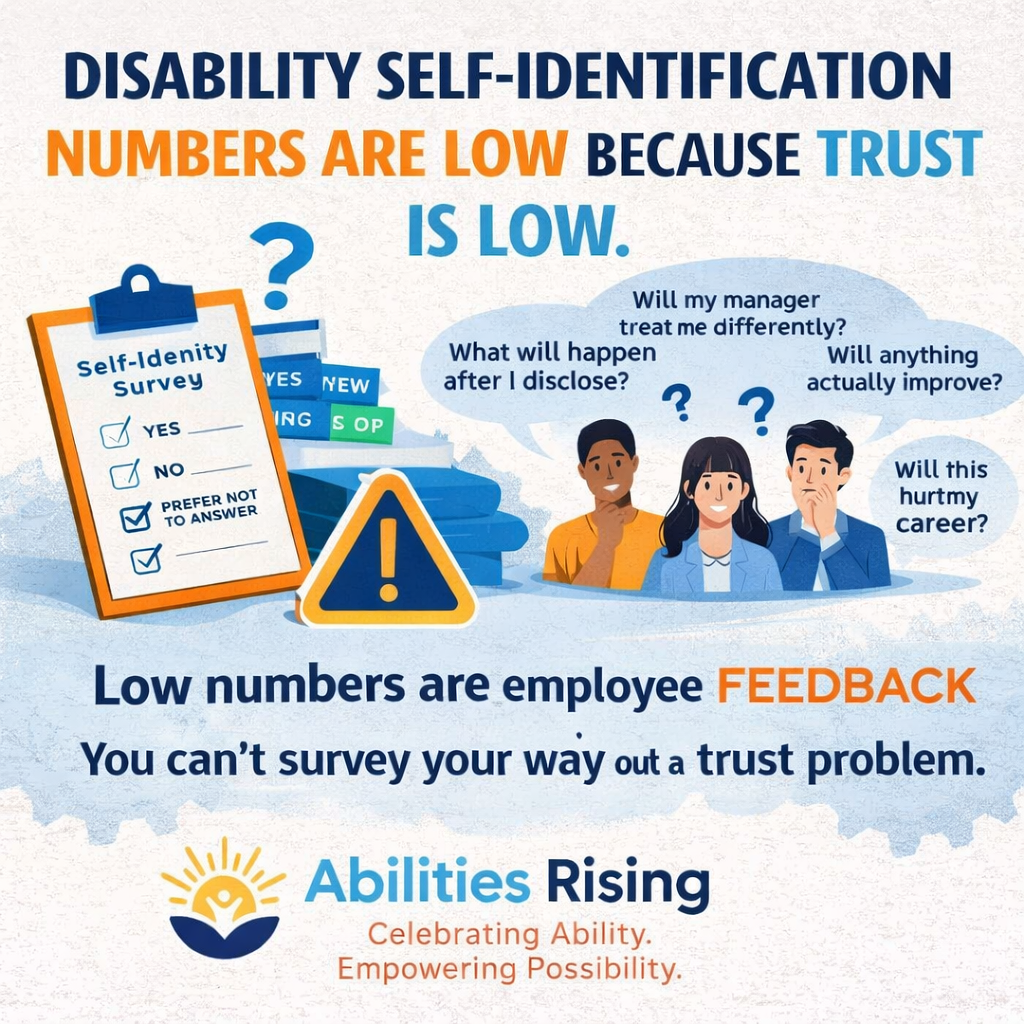
You Can’t Survey Your Way Out of a Trust Problem
Low self-identification rates are not a data problem.
They are not a communication problem.
They are not a form design problem.
They are a trust problem.
Employees don’t withhold disclosure because they are disengaged. They withhold disclosure because they are unsure what will happen after they disclose.
And no amount of survey optimization fixes that.
What Employees Are Really Asking
When an employee considers self-identifying, they are silently asking:
- Will this information be used against me?
- Will my manager treat me differently?
- Will this limit my growth or opportunities?
- Will I become a “problem to manage”?
- Will anything actually improve because I disclosed?
If the organization cannot answer those questions through lived experience—not policy—employees make a rational choice.
They stay quiet.
Why Senior Leaders Misread the Data
At the executive level, low self-ID numbers are often interpreted as:
- “We don’t have many employees with disabilities”
- “Our workforce isn’t affected”
- “This isn’t a major issue for us”
That conclusion is almost always wrong.
Disability is broad, dynamic, and often invisible. Many people acquire disabilities during their careers. Others live with conditions they’ve learned to manage quietly.
Low disclosure doesn’t mean low prevalence.
It means low confidence.
The System Behind the Silence
Self-identification rates reflect how safe people feel inside your systems.
Ask yourself:
- Do managers know how to respond when someone discloses?
- Are accommodations handled smoothly—or painfully?
- Is there a history of follow-through, or of delay and deflection?
- Do employees see others disclose and succeed?
If the system is unclear, inconsistent, or slow, employees notice—even if leaders don’t.
Trust spreads horizontally, not vertically.
What We Learned Building a Real Business
At John’s Crazy Socks, disclosure was never driven by forms or campaigns. It emerged organically as trust grew.
Why?
Because people could see:
- accommodations weren’t treated as exceptions,
- managers weren’t afraid of the conversation,
- support didn’t derail careers,
- and inclusion was part of how work actually happened.
We have seen others find success when they work on changing the environment. TD Bank doubled its self-disclosure rate in one year.
People don’t disclose because they’re asked. They disclose because it feels safe.
Why This Matters More Than Metrics
Self-identification data is often framed as a measurement goal. But treating disclosure as a KPI misses the point.
Disclosure is not the objective. Trust is.
When trust is present:
- disclosure follows,
- accommodations improve,
- engagement rises,
- and systems get stronger.
When trust is absent:
- forms go unanswered,
- data stays incomplete,
- and leaders are left guessing.
A Better Question for HR Leaders
Instead of asking:
“How do we increase self-identification rates?”
Ask:
“What experiences have we created that make disclosure safe—or risky?”
The answer to that question won’t be found in a survey platform.
It will be found in how managers act, how systems respond, and whether the organization does what it says it will do.
Final Thought
Low self-identification is not employee resistance. It is employee feedback.
And the message is simple:
You can’t survey your way out of a trust problem.
These are the conversations John and I have with senior HR leaders and executives who are ready to move beyond surface-level inclusion efforts and into real operational change.
Because when trust is built into the system, disclosure stops being risky and starts being useful.