“Never be blinded by a person’s limitations. Be awed by their possibilities.”
Too often, we focus on what people cannot do. In hiring, we create job descriptions that want a Renaissance Man or Woman, when that is not what we really need. We need someone who can fill a specific role and do it well. I
Peter Drucker saw this problem decades ago. He didn’t write about disability inclusion. He wrote about management failure. And if you read The Effective Executive closely, especially Chapter Four, Making Strength Productive, you realize something uncomfortable:
Most organizations don’t struggle to hire people with differing abilities.
They struggle to manage anyone who isn’t average.
Drucker’s Uncomfortable Claim: The “Well-Rounded” Employee Is a Myth
Drucker dismantles one of management’s favorite fantasies: the idea of the well-rounded employee.
He argues that people who produce exceptional results do so because of pronounced strengths, not balanced skill sets. And those strengths inevitably come with real weaknesses. That’s the tradeoff. Excellence is asymmetrical.
Trying to eliminate weaknesses, Drucker warns, doesn’t create greatness. It creates mediocrity.
Yet look at how we hire:
- Endless competency matrices
- Job descriptions demanding ten skills when three actually matter
- Interview processes designed to surface “red flags” instead of value
We pretend we are selecting for excellence while quietly filtering for conformity.
That system appears to work fine until you try to hire someone with intellectual or developmental disabilities. Then the flaw becomes impossible to ignore.
Disability Inclusion Doesn’t Break the System, It Reveals It
When leaders say, “We support inclusion, but we’re not sure how to make it work,” what they usually mean is:
“Our jobs are poorly designed, our managers are undertrained, and our culture depends on people fitting an unspoken mold.”
People with differing abilities expose that reality immediately. Their strengths and limitations are visible. You can’t hide behind vague expectations or lazy job design.
And instead of fixing the system, many organizations retreat by blaming “risk,” “complexity,” or “readiness.”
Drucker would call that what it is: abdication of leadership.
What Drucker Actually Demanded of Leaders
Drucker was relentless on one point: leaders are responsible for results, not excuses.
Making strength productive is not about being kind. It is about being disciplined:
- What outcomes actually matter?
- Which strengths produce those outcomes?
- How should work be structured so those strengths can dominate?
If you cannot answer those questions clearly, inclusion isn’t your problem. Management is.
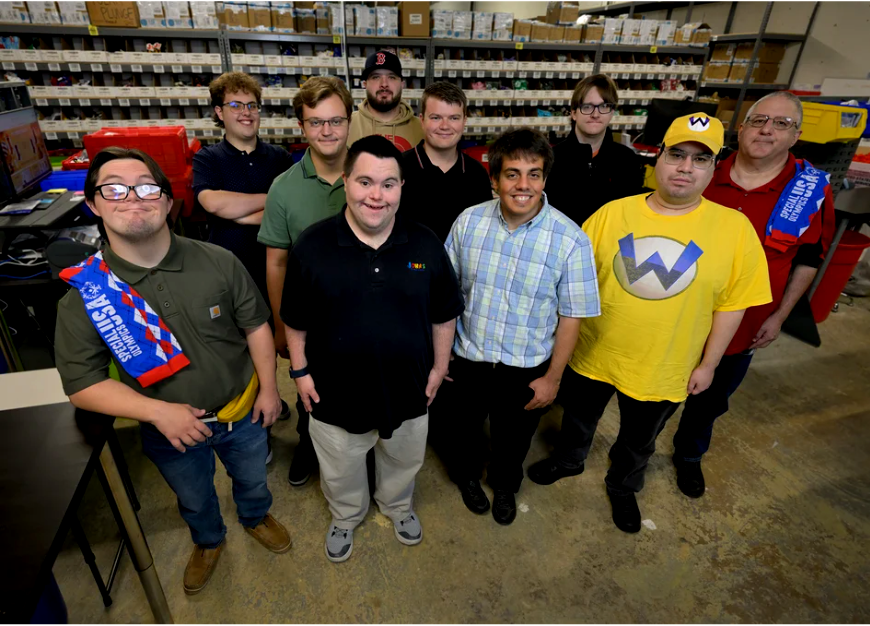
At John’s Crazy Socks, more than half of our colleagues have differing abilities. We didn’t start with a policy. We started with Drucker’s questions, even if we didn’t name them that way at the time.
We learned quickly: when you design work around outcomes instead of habits, talent shows up everywhere.
The Lie at the Heart of Most Job Descriptions
Here’s the part few HR leaders like to hear:
Most job descriptions are fiction.
They are laundry lists of tasks accumulated over time, not reflections of what actually drives value. They confuse activity with contribution. They reward endurance over effectiveness.
That’s why hiring people with differing abilities feels “hard.” Not because the people are incapable, but because the job itself is incoherent.
Drucker warned against this exact mistake. He argued that organizations must stop expecting individuals to compensate for bad design.
If a role truly requires ten unrelated competencies, it’s not a role; it’s a failure of thinking.
Inclusive hiring forces a reckoning: What really matters here?
Generalist Thinking Is the Enemy of Inclusion
Drucker was skeptical of generalists for a reason. The belief that everyone must do everything leads to shallow performance and fragile systems.
Yet HR systems are built on this assumption. Everyone must:
- Communicate the same way
- Learn the same way
- Work at the same pace
- Navigate the same ambiguity
That is not fairness. That is convenience.
People with differing abilities don’t fit that model and, if you’re honest, neither do your best performers.
Inclusive organizations succeed because they abandon the fantasy of uniformity. They design roles, teams, and workflows that let strengths dominate and weaknesses recede into irrelevance.
That’s not accommodation. That’s competence.
Diversity Isn’t the Goal. Performance Is.
Drucker never argued for diversity as virtue signaling. He argued for it because different strengths produce different results.
Homogeneous teams feel efficient until conditions change. Then they break.
People with differing abilities add cognitive diversity, emotional intelligence, pattern recognition, consistency, and resilience. Consider the programmer on the autism spectrum who joined IBM, and when he arrived at a client site to support a QA program, saw flaws in the programming that no one else had seen. He revamped the program and earned new patents for IBM. That happened because he brought a different perspective to the table, a different way of looking at things.
Consider one of our sock wranglers who also happened to be on the autism spectrum. He recognized a problem with an order because he knew the structure every order should take, and this one didn’t make sense. It was his fixation on patterns that headed off a problem. Again, neurodiversity in hiring brought a range of perspectives that strengthened our business.
That’s why organizations that get this right don’t talk about disability hiring as charity. They talk about it as talent strategy.
And they outperform.
The Real Reason Inclusion Fails
Let’s be direct.
Inclusion fails when:
- Managers are promoted without being taught how to manage
- HR optimizes for compliance instead of capability
- Leaders delegate culture instead of owning it
People with differing abilities aren’t the challenge. They are the mirror.
Drucker would say the same thing today: if your organization can’t make strengths productive, it doesn’t deserve the talent it already has let alone the talent it excludes.
A Final Challenge to HR and Executive Leaders
We need to challenge ourselves. We need to ask if that job description truly fits the job. We need to see why the person in front of us can do the job, not look for reasons not to hire them.
Peter Drucker left us a blueprint. Inclusive hiring isn’t a deviation from it, it’s the proof that you understand it.
And if your organization is serious about moving from intention to execution, that’s the work John and I do every day with leaders, managers, and HR teams across the country.
Not inspiration. Not slogans.
Management, applied.
Because when you stop being blinded by limitations, possibilities become operational.