Most organizations say they are mission-driven. Very few are willing to let their mission actually drive decisions.
Mission statements are easy. Posters are easy. Websites are easy.
What’s hard is letting purpose dictate behavior when there is money on the table or when the moment would be perfect for a promotion.
At John’s Crazy Socks, we’ve learned that the truest test of mission isn’t found in strategy decks or keynote slides. It shows up in ordinary moments: how we treat customers, how we celebrate milestones, how we respond when the obvious move would be to maximize short-term gain.
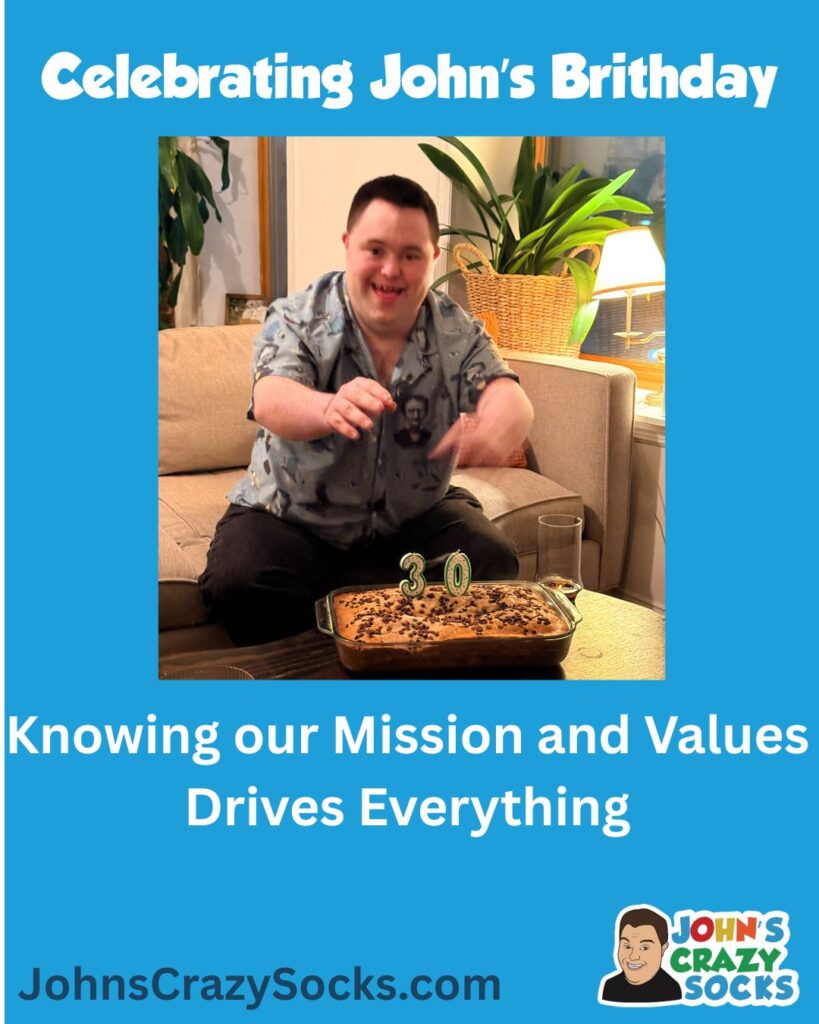
One of those moments arrives every year on my son John’s birthday.
A Birthday as a Leadership Test
John is the co-founder and Chief Happiness Officer of John’s Crazy Socks. He’s also a young man with Down syndrome. Together, we built a business with a simple mission: Spreading Happiness.
When John’s birthday comes around, the business faces a choice.
Most brands would see it as a marketing opportunity:
- Run a sale
- Push urgency
- Drive transactions
That approach works, but only in the short term.
But it conflicts with who we are. We know that everything we do has to be guided by our mission and our values. Those values include:
- Giving back
- Making things personal
- Building relationships, not just transactions
If we turned John’s birthday into a sales gimmick, we’d be saying, without meaning to, that our mission matters only when it’s convenient.
So, we made a different choice.
What Mission Looks Like in Practice
Instead of centering the day on what we could extract from customers, we focused on what we could give.
Here’s how our mission shows up in action on John’s birthday:
- Giving Back: For every order, we donate $1 to Special Olympics New York
- Gratitude: Every order includes a free gift, a pair of mystery socks
- Gratitude: We add extra candy to every package
- Making It Personal: John spends the day calling customers to thank them
- Gratitude (Yes, Still): We offer a discount
I tease John that he’s like a hobbit: giving gifts on his birthday instead of receiving them.
But this isn’t about being clever or sentimental. It’s about consistency.
Mission Is Not a Marketing Strategy, It’s an Operating System
Too many leaders treat mission as branding. Something to talk about on stage or feature in recruiting materials.
That’s a mistake.
A real mission functions as an operating system:
- It tells you what not to do
- It simplifies decisions
- It creates alignment across the organization
When the mission is clear, choices become easier, even when they appear counterintuitive.
On paper, giving away product, donating money, and slowing operations so John can call customers makes little sense if the only metric that matters is short-term revenue.
But when the metric is trust, the logic flips.
Why This Works (and Why It Scales)
Here’s the part that surprises people:
Sales don’t suffer.
They take care of themselves.
Why? Because customers can tell when they’re being treated as humans instead of transactions. They remember how you made them feel. They come back. They tell their friends. They become advocates.
Mission-driven business isn’t soft.
It’s durable.
It builds:
- Loyalty instead of churn
- Engagement instead of indifference
- Pride instead of compliance
And it creates something every organization wants but few achieve: a community, not just a customer base.
This Isn’t About Socks
We don’t share this story because everyone should celebrate birthdays the way we do.
You may have a different mission.
You may have different values.
You may operate in a completely different industry.
That’s the point.
Mission-driven leadership is not about copying tactics.
It’s about alignment.
When a moment arrives — a founder’s birthday, an anniversary, a crisis, a windfall — your response reveals what truly drives your organization.
The Question Every Leader Should Ask
The real question isn’t, “What would maximize revenue today?”
It’s this:
Do our actions reflect our values or contradict them?
If the answer isn’t clear, then the mission isn’t doing its job.
Why We Speak About This
John and I speak to organizations because work changes lives and because purpose-driven businesses consistently outperform those driven only by transactions.
We don’t speak in theory.
We speak from lived experience.
We’ve built a business where:
- More than half our colleagues have differing abilities
- Inclusion drives productivity, retention, and morale
- Purpose simplifies leadership decisions
- Joy becomes a competitive advantage
Mission isn’t charity.
It’s strategy.
And when leaders are willing to let it guide real decisions — even small ones — it becomes transformative.
If you’re interested in exploring what mission-driven leadership looks like in practice (in hiring, culture, customer experience, and growth), John and I would love to continue the conversation.
Because when mission is real, it doesn’t just inspire.
It works.